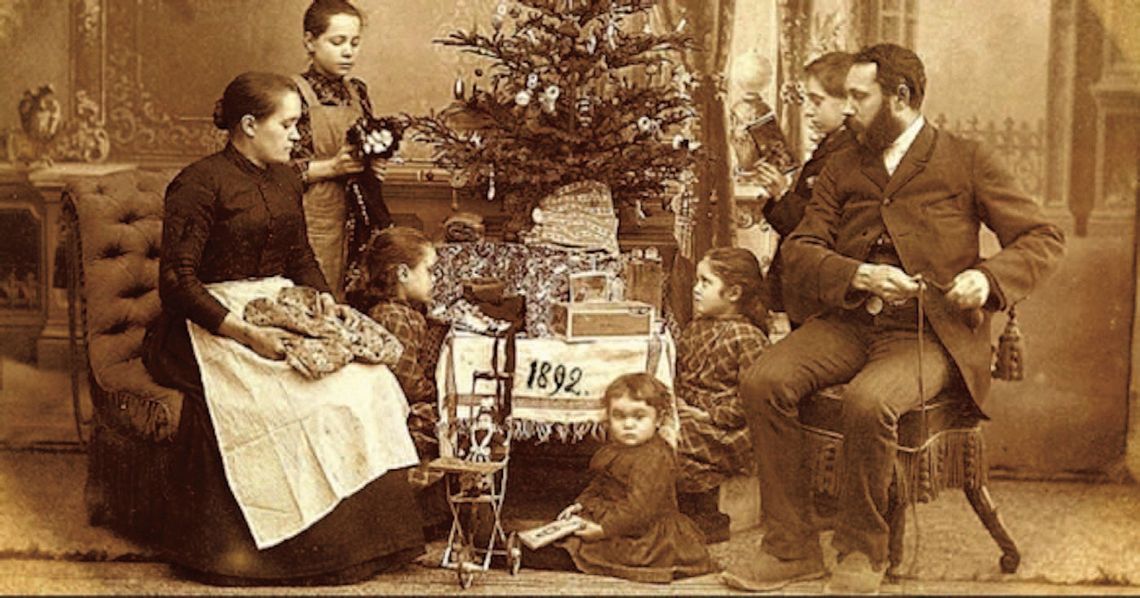
Christmas on a Sherman County Homestead, 1884
Amos Edwin Donnell, Sherman County homesteader, left a record of his activities between 1884 and 1888 in the form of letters written to his parents in Missouri. The letters, written at intervals of two or three months, record his hopes, his hard work, successes, and failures. Among other topics, he reports on the coming of the railroad to Loup City, a well digging project, and his marriage in 1885 to Ettie Terhune, a Sherman County neighbor.
Nebraska History (June 1960) includes selections from several of the letters that report Donnell's first Christmas in his sod house. On Dec. 24, 1884, he wrote his parents: “It has been cold the last two weeksbeen snowing a good share of the time. It has been 22 below. They say it is colder than they ever saw it before.
“Tonight is Christmas Eve. Where are you all going? I am going to set by the fire at home in my sod house.
If it is not too cold tomorrow I am going a deer hunting. We have been out twice this winter and killed four, 2 doe and bucks. We divided equal, there was four of us out.”
Several months later, Donnell wrote to his mother about his holiday presents: “I told you I got 2 Christmas presents and I got 2 more since. One is a match safe made out a black cloth trimmed in blue with three blue tassels, and a watch pocket to hang on the wall-it is made out of green cloth all flowered with red crochet work and three silk beaus [bows], 1 at the top and one on each side. A nice meat dish, and a shaveing mug that cost 75 cents. Dud [Dud Godard, a fellow homesteader from Missouri] gave me that.”
Because of the hard work, the severe climate, and his consequent failing health, Donnell left the Sherman County homestead soon after 1888 and moved his family to Arcadia, where he engaged in business for 28 years. He died at Hulett, Wyoming, in 1921.
A Midsummer Christmas Eve
The Christmas of 1889 in Omaha was memorable chiefly for the record high temperatures recorded there. The Omaha Daily Bee on Dec. 25, under the headline “Mid-Summer Christmas Eve," reflected the astonishment of local holiday observers who experienced anything but a white Christmas.
The Bee said: “It may be doubted if Christmas Eve in Omaha was ever characterized by the summer weather which prevailed yesterday. The thermometer at noon noted 73 degrees.
[Official records listed a high of 68 degrees, still the warmest Dec. 24 in Omaha’s history.] Accordingly, heavy coats were cast aside, doors and windows were opened and in the hurrying throng on the crowded thoroughfares, men rushed hither and thither in their shirt sleeves. The most delicate fruits stood upon the hucksters’ stands, and horses on cars and private vehicles were bathed in perspiration.
“This unprecedented condition of the weather was the cause of unusual comment. It was appreciated by everybody except those whose line of business comprehends goods which are in demand in wintry weather. Many of these, however, jocularly, remarked that they intended to place again upon their shelves the unsold stock of the past spring and summer.
“To the poor and homeless, the weather has been a benediction. They have been spared the suffering and misery of cold in wretched hovels and tenements, while thousands have had their season[al] outdoor labor extended and their income swelled by what otherwise would have been unearned dollars.”
On its editorial page, the Bee noted: “It is an ill wind that blows nobody good. While the coal dealers are shivering for want of sustenance and the icemen are praying for a blizzard, the mechanics and men engaged in the building trades are singing on the scaffolding and on the roofs, blessing the Lord that the weather has been tempered to them.”
Omaha’s welcome reprieve from winter weather was brief, however. On Dec. 28, a thunderstorm with lightning, torrential rain, and then hail struck the city. The Bee said the next day: “About 7 o’clock the rain ceased and the wind began rising, blowing from different points of the compass, but gradually settling down to a northwester. At 10 o’clock the temperature began falling rapidly and the wind continued to increase in force until at midnight it had attained a velocity of nearly 45 miles per hour, blowing in irregular gusts.”
Temperatures were expected to reach 14 degrees above zero by the morning of Dec. 29. Winter had returned.